
Slay the Spire was the perfect roguelike deck-building game to create an obsession. I become infatuated with that game every time I boot it up. I will play other games, but I usually end my sessions with a few runs in Slay the Spire. I’ve been chasing that dragon for something like Slay the Spire — but a little different — ever since.
The funny thing is that I played Castle Morihisa before ever touching Slay the Spire — Castle Morihisa was basically a Slay the Spire clone, but I already went over that in a previous post. My one buddy convinced me to get into Slay the Spire, after I asked him about it — seeing that he had spent well over 250 hours with it on his Nintendo Switch.
I now realize that I haven’t been searching for another Slay the Spire. A direct sequel is set to release this year. I’ve been looking for more deck-building roguelike games that introduce something new to the genre. I recently came across three very different games within this genre.
Three Deck-Building Roguelikes
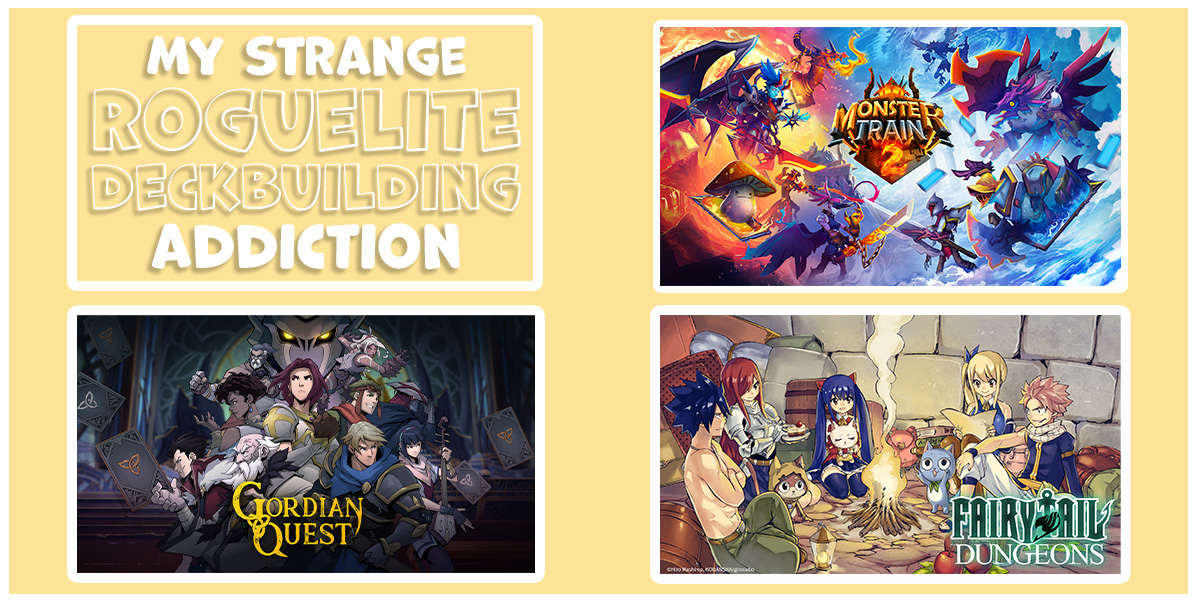
Any time I receive an email for a new “Roguelike Deck-Builder,” “Card Battler” or “It’s like Slay the Spire meets [insert other game title here]” my research begins. These emails led me to accumulating three interesting deck-builders in my backlog — Gordian Quest, Monster Train 2, and Fairy Tail: Dungeons.
These three games all feature similar card-fighting mechanics with deck-building. Still, each game feels so different from the next. From the way the battles take place on the combat field to the post- and pre-combat admin work. These three games would be classified in the same section, but they each give the player a unique experience.
In Gordian Quest you begin your quest with a pre-picked team of three heroes. Fairy Tail: Dungeons also lets you pick a specific hero (or heroes). However, in Monster Train 2, there is a setup phase where you lay out your heroes for that particular train battle — you also get the opportunity to add more to each floor as the battle continues.
Combat is also handled differently per each game. In Gordian Quest, all combat actions (both heroes and enemies) are handled by playing different cards from your deck. There are cards for striking, blocking, building up your shield, magic spells, and other abilities.
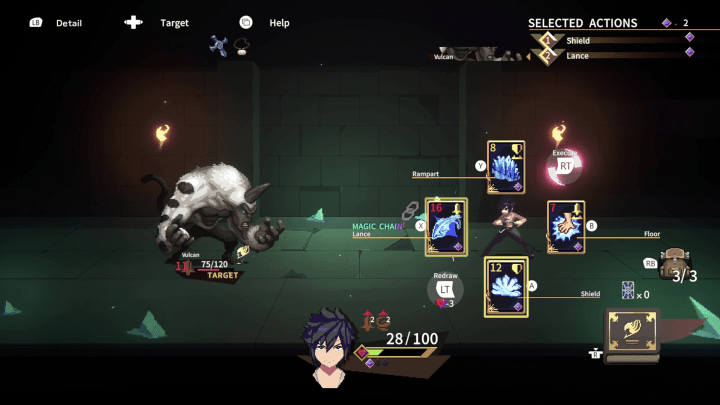
Fairy Tail: Dungeons’s combat is similar in that each hero has their three action points per round to play cards (most cost one-to-two action points). Cards can block, hit, heal, or modify future actions. There are also magic chains, which make the most out of your turn. Instead of playing cards, opponents just attack or defend. Big opponent actions can be countered by performing certain acts leading up to their action (ex. Deal X damage in the next two turns to stop this MONSTER ATTACK!).
When it comes to combat, Monster Train 2 is the most different of the bunch. It’s still a card battler, but instead of using cards to attack, the attacks are automatic. Cards are used to buff and de-buff, raise stats, or modify the upcoming combat phase. This one is more of a tower defense deck-builder, since you have your pyre at the top level that you are attempting to protect throughout your train journey.
Those are just a few similarities and differences between Gordian Quest, Fairy Tail: Dungeons, and Monster Train 2. Let’s give each of these games a little more time.
Gordian Quest
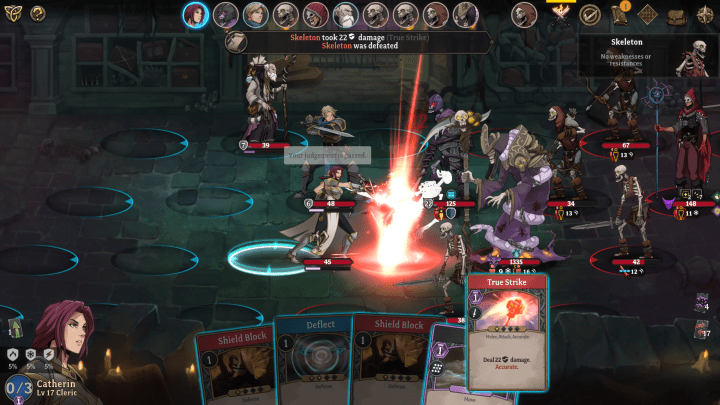
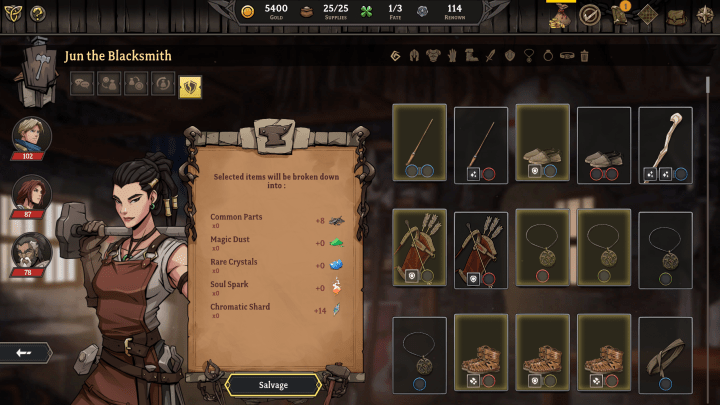
Of these three games Gordian Quest is the most complex of the group. It’s a full-on RPG within a roguelike deck-builder. There’s a base area where everything happens in between quests. Each character has their own leveling system, with pages upon pages of inventory, lore, equipment, and more.
Gordian Quest also pays homage to tabletop RPGs with the dice-rolling mechanics. Each battle starts with each character’s D20 rolling for initiative. From there we get an order of operations. That’s not all, the D20 is also used in between combat while exploring areas to make big decisions.
Card combat is a big part of Gordian Quest, but there is so much more to this game. I found myself overwhelmed at times with all of the admin work needed. I usually get into these games for the quick and challenging strategic card-battling. Not this one!
The funny thing is the more I played Gordian Quest, the more I started to explore the base and different parts of the menu, that’s when I really started to fall in love with this game. I started changing up my team of heroes for each quest. At one point I felt I had gone too far without really paying attention and I should start a new save.
Monster Train 2
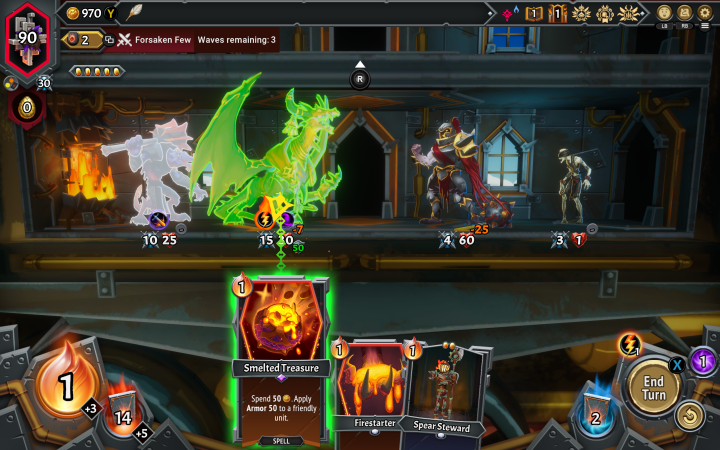
I have never played the original Monster Train, but I don’t think that really matters. Monster Train 2 is a little complicated at times, but not as complex as Gordian Quest. Everything happens within the quest. Once you depart on a quest, the battles and admin work are all there.
You ride the train from battle stop to battle stop, choosing your path in between (left or right) depending what you are looking to purchase and/or upgrade. One path may contain spell upgrades while the other provides character buffs.
I’ve been playing Monster Train 2 the longest from this bunch, but I’ve always liked the feeling of jumping in for a quick quest and quitting after I fail — I have yet to make it to the end of a quest in this one. Monster Train 2 isn’t the type of game you need to play consistently to remain skilled.
I’m now learning about different factions, and which ones work best for me and in combination. I just unlocked the fourth faction, which features mushrooms and fun-guys. I’m trying to learn how to fight with them correctly and which group they pair well with. For the longest time I was using the same two factions in battle.
As I stated before, this is the most different of the group when it comes to combat, since cards are used to set up and buff or de-buff before the auto-battles takes place. It is nice to see what’s going to happen during battle beforehand, and attempt to make it better for your team with cards. As you play cards you get more details on the upcoming damage to your foes.
Monster Train 2 also had some expansions and new DLC come out recently. There’s even some Balatro within this game in certain parts of the game you can unlock certain Jimbo modifiers.
Fairy Tail: Dungeons
Fairy Tail: Dungeons felt like the most simple of these three games, but the more I have played the more complex it has gotten. Still, it is the most simple of this bunch. I love the pixelated art style, that also goes with the games simplicity.
I first thought my main goal was to make it through this labyrinth one hero at a time, but once I did that it unlocked new ways to play. The first part of the game only allows for you to use one hero. After that I was able to bring a party of three along, which was much better.
In Fairy Tail: Dungeons you also go on quests, but through dungeons. Each round ends with a boss fight, but before that you have a specific number of moves on a game board to collect resources, find new cards, and battle foes. There are also camping areas.
Each hero has their rolodex of cards and powers. As you make your way through the dungeon you get to add cards, upgrade cards, or add modifiers to your heroes. The battle portion is much simpler. Each round you have four cards to choose from, which may cost between one and three action points. Use your three action points to prepare the right combo of blocking and striking.
This game is based on a specific IP, Fairy Tail, an anime. After playing the game I’d like to check some of it out and learn a little more about some of these characters. If you are already into Fairy Tail (the anime) maybe you’d be into this game. I’ve gotten into games that I would never be into thanks to familiar IP.
What Comes Next?
I’ve enjoyed jumping between these three deck-builders, but I may end up giving most of my time to Gordian Quest now. That is the richest of the three, with so much more to do. I usually don’t go for that kind of thing. I like sticking to roguelikes that are quick and easy to get to the action — go through a run, then come back later when you’re ready to try again.
After getting into more and more large-scale action RPGs these past few years, I want to plan out my team and build each hero up. I want to strategize during combat, not just play whatever card does the most damage.
All three games deserve more of my time, but sometimes while playing in bed I’m just trying to get through a quick run. We play games differently whether we are tired or wide awake, or have two minutes or one hour, or we’re playing on handheld or on the big screen. It’s nice that we can play games when and wherever we want these days, but certain games demand specific conditions.
I’m looking forward to continuing all three of these games, but yes I do plan on giving a little more time to Gordian Quest and all of its complexities right now. I really want to figure that game out. I still plan to continue playing Monster Train 2 and Fairy Tail: Dungeons as well.
 VIDEO GAME BOOK CLUB