
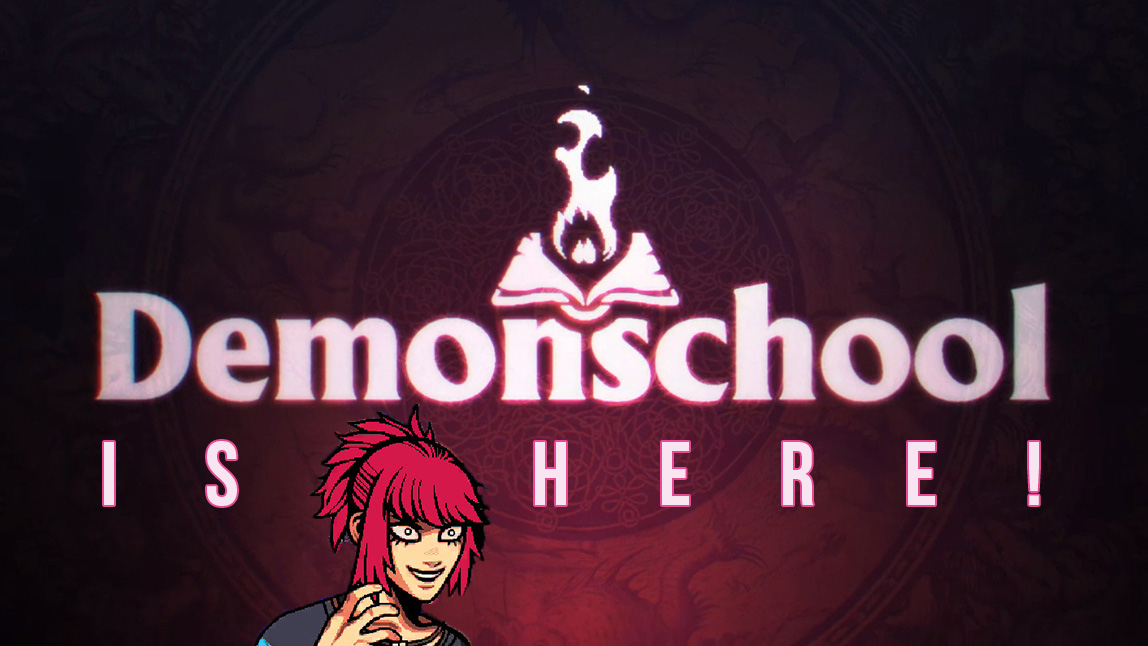
Demonschool has been a highly-anticipated game since it was first announced in the summer of 2022. It finally came out last week. The original reveal trailer gave off some retro Stranger Things vibes, which is also back with a new season on Netflix later tonight — but that is an unrelated coincidence.
“Demonschool is a school-life tactics RPG with hints of Persona, Shin Megami Tensei, and
Italian horror cinema from developer Necrosoft Games and publisher Ysbryd Games.”-from the publisher

I’ve become obsessed with solving the mysteries of Demonschool over the past week or so, and this is all thanks to both the turn-based combat and the game’s story.
TCG | Tactical Combat Games & Trading Card Games
In recent years, I’ve given more tactical games with turn-based combat a chance. It mainly started with the Mario + Rabbids series. I have since played some XCOM, Marvel’s Midnight Suns, Fire Emblem, and some others. Another recent indie title in this realm is Remnants of the Rift, which just released on PlayStation and Xbox last week — after being available on Switch and PC since last year.
What I enjoy about jumping from game-to-game in this genre is that the basic concept is similar, but each game features its own specific set of rules. I’ve always been into tabletop gaming, but I started to become more open to turn-based games after getting into more TCGs (trading card games) in real life.
My most recent TCGs include Disney Lorcana, Riftbound: League of Legends, Union Arena, and of course the OG TCG, Magic the Gathering. I’ve collected and played Magic the Gathering on-and-off for years with friends, but this year I attended my first ever draft night and my first pre-release event — for the recent Magic the Gathering X Avatar: The Last Airbender set.
Having a basic grasp on any of these popular TCGs means you’ll probably have an easier time learning others — this same rule of thumb also applies to many tabletop games. There are always commonalities within gameplay, rules, and other aspects. Some terms may change, but many mechanics stay the same.

Demonschool’s combat takes place on a gameboard, broken into square tiles. Each character has their own range of movement and attacks or abilities. Combat is broken into two phases — planning and action.
While there’s no deck of cards in Demonschool, the planning phase is the reason I brought up TCGs and tabletop gaming in the first place. In any TCG you usually have a few different options per turn, depending on your hand. What’s great about Demonschool’s planning phase is that you get to see the many ways your actions may play out prior to making your final decision.
In a real life TCG and tabletop game you wouldn’t get a chance to test out different options, unless you asked your opponent to leave the table. If not, you’d reveal all of your choices. It’s nice to have the chance to see how everything can and will play out in Demonschool before moving onto the action phase.
I’ve never been particularly great at tactical turn-based games, because I don’t normally pay much attention to the secondary information — which weapons, abilities, or costumes are going to help the most in each battle. In Demonschool thus far, I’ve had some great battles and some not so great ones, but I usually make it out alive — perhaps I’m finally applying my real-life game skills to this one.
Each battle is also rated at the end, so you can instantly see how great (or not so great) it went for you. I’ve passed a few with an “A” grade, but I’ve also scored plenty of “B” and “C” grades. I’d say I have a “B” or “B+” average at the moment in Demonschool.
Demon Story | The MacGuffin
I’m also really digging the non-combat elements of Demonschool. The game begins by ripping off the story of the 2002 horror movie, The Ring. I was chasing after this VHS-tape that would kill anyone who watched it “within three days” of viewing it.

I was thinking this could be the whole point of the game and that would be silly and totally fine by me. The dialogue and writing is still original and fun. The whole The Ring plot ended up being a MacGuffin*. This was just the plot during the tutorial phase of Demonschool, up until the first boss fight — vs a monster made up of TV screens.
*MacGuffin — an object, device, or event that is necessary to the plot and the
motivation of the characters, but insignificant, unimportant, or irrelevant in itself.-from Wikipedia
After The Ring MacGuffin opening, the game continued to borrow concepts and ideas from previous films, games, and pop culture. The game takes place in the ending days of the year 1999, so I see these being used as inspiration. When creating a story in a particular time period, you kind of have to make references to that time period.

Once you get past the opening, the game’s RPG elements begin to take shape. New combat abilities can be studied, extra combat companions are discovered, and the story continues to open up. There are even short side story missions to be found in different locations.
One of my favorite “side quest” elements from Demonschool is the whole fishing mini-game, which was featured in the video above. I am now determined to catch every single fish in this game. I still have a long way to go in Demonschool, but I wanted to share my experience so far. I hope to make it to the end of this game soon — or at least catch all the fish.
*myVGBC.com was given a review code for Demonschool by the publisher.
 VIDEO GAME BOOK CLUB